How to Choose Post Packaging for Global Shipping?
Choosing post packaging for global shipping is not simply a matter of picking the strongest carton. It is a risk decision involving distance, handling, weather, customs presentation, and customer expectations. A package may leave a warehouse in Singapore and arrive weeks later at a wet northern port. That journey changes the packaging requirements. Start with the product. Record its weight, dimensions, fragility, moisture sensitivity, and temperature limits. Then examine the route, including transfers, storage conditions, and compression from stacked parcels. Corrugated cartons, padded mailers, molded inserts, and water-resistant wrapping each solve different problems. The cheapest option can become expensive after one crushed corner or a delayed replacement. Small details matter. A tight fit reduces movement, while excessive empty space increases material use and impact risk. Still, no material performs perfectly in every lane.
Reliable decisions should combine packaging tests with evidence from real shipments. Drop testing, vibration checks, compression trials, and seal inspections can reveal weaknesses before dispatch. However, laboratory results are only a starting point. Track damage rates, customer feedback, and carrier handling patterns across destinations. A practical packaging review should also consider recyclable materials, readable labels, and consistent packing instructions. Do not assume a familiar box suits every market. That assumption can create avoidable failures. Lighter mailers may look efficient, yet their seams can weaken after repeated handling and humidity exposure. The better approach is to compare protection, cost, sustainability, and packing speed together. This guide explains how to make that comparison with clearer criteria and fewer guesses. Packaging should protect the product without creating a new problem.
Define Parcel Size and Weight Against Global Carrier Limits, Including 30 kg Norms
Global shipping begins with a parcel that fits the route, not only the product. The 2023 Pitney Bowes Parcel Shipping Index reported 161.8 billion parcels worldwide in 2022. That scale makes small packaging errors expensive. Measure the packed length, width, height, and actual weight. Record them in centimeters and kilograms. A box weighing 8 kg may still incur a higher charge if its volumetric weight exceeds its scale weight.
A common air-shipping formula is length × width × height ÷ 5,000 or 6,000. The divisor depends on the carrier and service. For example, a 60 × 40 × 30 cm carton equals 14.4 kg at a 5,000 divisor. Check the published rule. Do not assume a 30 kg limit applies everywhere. Postal and express networks often use 30 kg as a practical ceiling, while some destinations, services, or remote areas allow less. The Universal Postal Union’s Parcel Post Manual shows that weight and size conditions vary by destination and postal product.
Leave handling space. But not too much. Heavy items need dense, stable packing, while fragile products need cushioning without creating an oversized carton. Weigh the final parcel after sealing, including labels and protective materials. A warehouse trial can reveal a problem: the first carton may protect the item well but trigger dimensional charges. Recheck the weakest measurement, especially height. Packaging teams should keep a country-by-country limit sheet, dated and verified against current carrier guidance. Rules change, and old spreadsheets quietly create new costs.
How to Choose Post Packaging for Global Shipping?
Compare common maximum parcel-weight reference points when selecting packaging for international delivery. A 30 kg package is a widely used planning threshold, but the final limit depends on the destination, service type, dimensions, and handling rules.
Packaging guidance: Keep standard parcels at or below 30 kg whenever possible. Use strong double-wall packaging, protect empty space, and check both actual weight and dimensional weight before dispatch. Values shown are common reference limits rather than universal carrier guarantees.
Match Packaging Strength to ISTA 3A’s 17-Drop and Vibration Tests
How to Choose Post Packaging for Global Shipping?
Global parcels face drops, vibration, compression, and changing humidity. UNCTAD’s Review of Maritime Transport 2023 estimates that over 80% of world merchandise trade by volume moves by sea. Even air and road parcels may pass through several sorting systems. Packaging must survive movement, not just look sturdy.
ISTA 3A is a practical benchmark for parcel delivery packaging. For many parcel configurations, its sequence includes 17 drops, vibration testing, and atmospheric conditioning. Drop impacts expose weak corners, seams, and closures. Vibration creates repeated rubbing between the product and its inner protection. A thick carton is not automatically safer. If the product moves inside, impact energy still reaches it. Choose board strength according to product weight, shape, fragility, and shipping distance. Use fitted cushioning around glass, electronics, or sharp edges. Keep internal movement minimal, but avoid excessive pressure on delicate surfaces. The exact 3A sequence varies by package type and weight, so testing the wrong configuration can produce misleading confidence.
Tips: Measure the packed product, not the empty carton. Test samples after humidity conditioning. Inspect crushed corners, loose closures, scuffed surfaces, and hidden product damage. Record every failure. A package that passes once may still need redesign; real distribution is less controlled than a laboratory. That uncomfortable gap deserves attention. Cite the current ISTA 3A procedure and your transport lane data before approving production packaging.
Select Materials Using ISO 18601’s Five-Level Packaging Hierarchy
How to Choose Post Packaging for Global Shipping?
Select Materials Using ISO 18601’s Five-Level Packaging Hierarchy
Choosing post packaging for global shipping starts with ISO 18601’s five-level hierarchy. Treat it as a decision path, not decoration. The first level is prevention: remove unnecessary void space and avoid oversized cartons. A snug mailer reduces material use, dimensional weight, and movement during handling. Next, consider reuse. A durable box with a second-use closure can support return shipments. However, customers may reject it if opening feels difficult. Reuse fails when convenience disappears. Keep it practical.
Recycling follows reuse. Select compatible paper or plastic components, and avoid bonded layers that local facilities cannot separate. This is where experience matters. A package may be technically recyclable yet rejected by a regional sorting line. Energy recovery has a narrower role when recycling is impractical. Disposal should remain the final option. Test packaging through humidity, compression, vibration, and temperature changes. I once underestimated corner damage on a long-distance route. A stronger insert solved it, but increased material use. The better answer was not obvious. Test early.
Tips: Measure empty space, package weight, return rates, and damage claims. Check destination-market disposal guidance before selecting materials. Ask suppliers for verified composition data, not broad sustainability promises. Run small transit trials before scaling. Document every change, including failures, because packaging decisions should improve with evidence.
Protect Goods from 95% Relative Humidity and International Climate Shifts
How to Choose Post Packaging for Global Shipping?
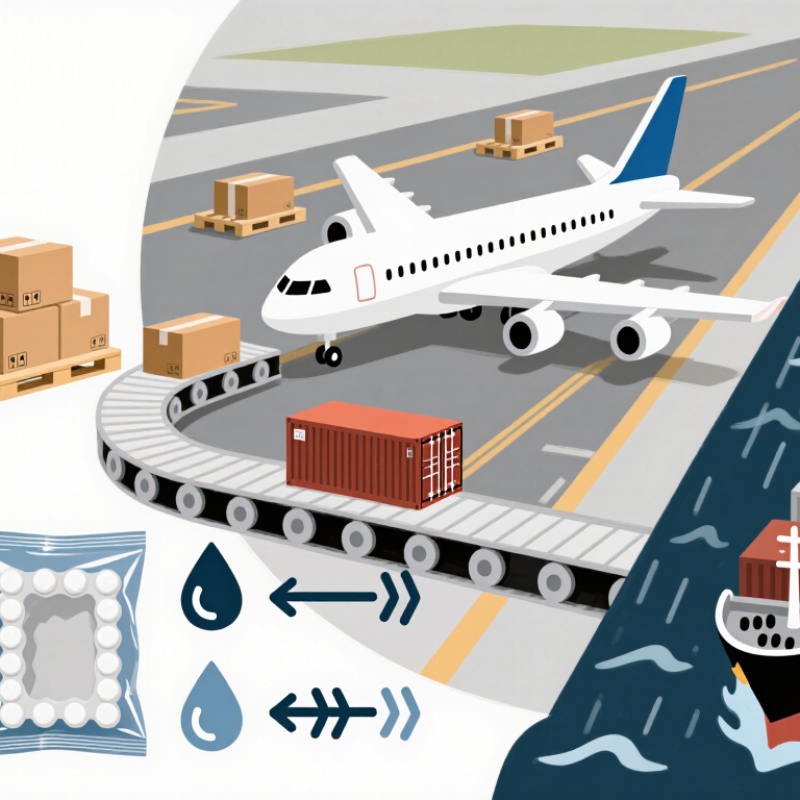
Global parcels can move from a dry warehouse to tropical air within hours. The WMO’s State of the Global Climate 2023 reported record ocean heat and widespread climate extremes. These shifts increase condensation risks inside cartons, especially near 95% relative humidity. Moisture wins quietly.
Choose packaging as a system, not a single box. Use moisture-resistant outer cartons, sealed inner liners, and desiccants sized for product mass, transit time, and package volume. Add humidity indicators when cargo is sensitive. Corrugated fiberboard can lose compression strength as humidity rises, so test the complete pack, not only the material. ASTM D4332 uses controlled conditioning near 23°C and 50% RH; a 95% RH scenario needs additional validation. That gap matters.
Sea freight carries over 80% of global trade by volume, according to UNCTAD’s Review of Maritime Transport 2023. Packaging should therefore withstand long dwell times, port exposure, and repeated temperature changes. Apply ISTA distribution testing with high-humidity conditioning, vibration, drops, and compression. Inspect corner crush, liner seals, and moisture readings after testing. Do not assume a thicker carton solves everything. It may trap humid air. In some designs, controlled venting works better, but it requires careful dust and water protection. Field data should guide revisions, because laboratory success can still miss real container conditions.
Verify UN 38.3 Packaging Rules for Lithium Batteries in Global Transit
How to Choose Post Packaging for Global Shipping?
Verify UN 38.3 Packaging Rules for Lithium Batteries in Global Transit
Lithium battery packaging begins with verification, not box selection. UN 38.3 confirms that the cell or battery design passed required transport tests. Ask the supplier for the UN 38.3 test summary before preparing export documents. Check the battery type, watt-hour rating, quantity, and shipping condition against the current transport rules.
The battery must be protected from short circuits, movement, crushing, and accidental activation. Use non-conductive inner materials, secure terminals, and strong outer packaging. A loose battery sliding inside a carton is a warning sign. For damaged, defective, or recalled batteries, normal postal procedures may not apply. Do not guess.
Packaging rules can change by transport mode and destination. Air, sea, road, and postal networks may impose different limits, labels, documents, or quantity controls. UN 38.3 is essential, but it does not replace those additional requirements. Confirm the latest rules with the carrier, a qualified dangerous-goods specialist, or the relevant national authority.
Small details matter. Record the test summary, packing method, battery quantity, and inspection date. Photograph the closed package when practical. This creates useful evidence if a shipment is questioned. A checklist helps, but it is not perfect. Recheck unusual battery sizes, mixed shipments, and reused cartons before dispatch.